University of Wisconsin Digital Collections
Link to University of Wisconsin Digital Collections
Digital Library for the Decorative Arts and Material Culture

Page View

Grigsby, Leslie B. (Leslie Brown) / The Longridge collection of English slipware and delftware. Volume 2: delftware
(2000)

Punch bowls,   pp. 332-354


Page 332

 
DELFTWARE ýBeverage Wares 
Punch Bowls 
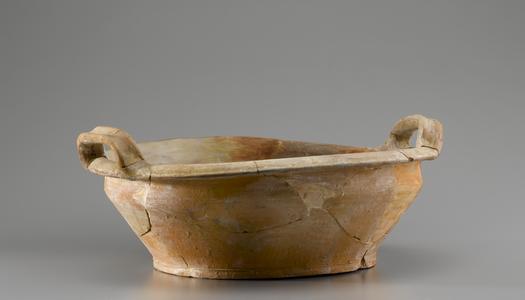
H.: 6 5/8" (16.8 cm); 
Diam.: 12 1/2" (31.8 cm) 
BODY CLAY: Medium-grained buff. 
TIN GLAZE: Pale turquoise with 
occasional large pits, blow holes, and 
poorly adhered patches. Overall, 
excluding footrim bottom. 
SHAPE: Thrown. 
DECORATION: Painted. Exterior bears 
Chinese landscapes with figures, rocks, 
fences, and plants. Borders composed 
of horizontal lines. Interior central 
reserve bears large ship flanked by 
smaller ones. Borders composed of 
concentric circles and band of foliate 
motifs. 
A     ccording to the Oxford English Dictionary, the earliest English reference
to 
punch is in a 1632 letter stating, "I am very glad you have so good
compani to 
be with .... I hop you will keep a good house together and drinke punch by
no 
allowanc." A 1696 definition for the drink describes it as "a kind
of Indian drink 
made of Lime-Juice, Brandy, and other Ingredients," and two years later
it was 
written that "At Nerule" they "make that enervating liquor
called Paunch (which 
is Indostan for Five) from Five Ingredients." This Hindi origin for
the drink's 
name was recorded as early as 1672, but there are indications of European
sources for the term as well. (Some recipes also contain more than five ingre-
dients.) Punch was being drunk from or served in bowls (see no. D315, interior)
by the late 1650s; a 1658 letter includes the words "Your Company, which
wee 
haue often remembered in a bowle of the cleerest punch, hauing noe better
Liquor." 
    Somewhat surprisingly, delftware punch bowls are not known to predate
the early 1680s. Based on its nearly hemispherical profile, the punch bowl
shown here dates to around that time. Another, dated 1681, is of about this
shape (under a stronger turquoise glaze), has a different Chinese-figure-in-land-
scape scene, and, on the interior, displays the Coopers' Company arms.' The
turquoise casts to the glazes and quirky painting styles may indicate that
the 
bowls are from Brislington, but the arms open the possibility of London as
the 
place of manufacture. 
   The trek painting style (compare no. D253) of the Longridge bowl's exterior
scenes and the particular ship motif are of northern European origin.3 A
re- 
lated boat appears between two small ships on an English dish with a zigzag
lozenge border (for a variation, see no. Dll); one such vessel is perched
on her- 
ringbone-type waves (see no. D72) and again flanked by two diminutive ships
on an early eighteenth-century plate excavated at the Brush-Everard House
in 
Williamsburg, Virginia.4 
1. Oxford English Dictionary, vol. 8, p. 1595, also 
including a 1653 reference, "Bolleponge Ithought 
to derive from 'Bowl of Punch') est vii mot 
Anglois, qui signifie vne hoisson dour les Anglois vsent 
aox indes faite de sucre, suc de limon, eau de vie, fleur 
de muscade, & biscuit rosty"; Grigsby, Chipstone, 
no. 27. "Kalendarium, 1650-1672," in Evelyn, 
Diary, vol. 3, p. 313, records that John Evelyn 
consumed "spiritous drinks, as Punch &c" on "an 
East India vessel" in 1662 and cites E. Phillips's 
New World of English words (1658), in which 
punch is defined as "a kind of Indian drink." 
2. See Archer, V&A, no. F.3. 
3. For a somewhat similar boat on a c. 1630- 
1650 Delft or Haarlem plate, see Scholten, van 
Drecht, no. 199. 
4. Unearthing New England's Past, no. 1 (Gold- 
weitz collection); Austin, Delft, p. 149, 
concentric-circles border. 
332 The Longridge Collection 
D304. PUNCH BOWL 
London or Brislington 
c. 1680 


Go up to Top of Page