Page View
Grigsby, Leslie B. (Leslie Brown) / The Longridge collection of English slipware and delftware. Volume 2: delftware
(2000)
Fuddling cups, pp. 316-321
Page 316
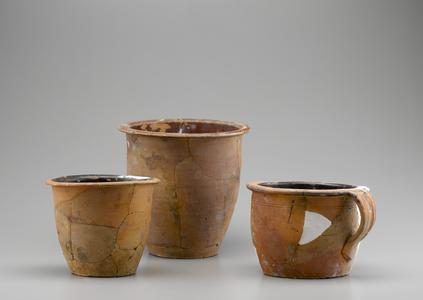
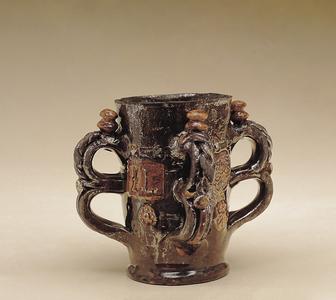
D290, D291. FUDDLING CUPS
London, probably Southwark
(D290) Dated 1641
(D291) 1635-1660
(D290) H.: 3 3/8" (8.6 cm);
Diam.: 5 5/8" (14.3 cm)
(D291) H.: 3 1/2" (8.9 cm);
Diam.: 5 3/8" (13.7 cm)
BODY CLAY: Medium-grained buff.
TIN GLAZE: White (D290), slightly
transparent, (D291) slightly greenish and
runny. Bottoms unglazed.
SHAPE: Thrown. Rolled and twisted
handles, Joined bellies of vessels
pierced to form single, larger vessel.
Rough-textured bottoms with slightly
concave centers.
DECORATION: Painted. (D290)
Inscribed "1641 BR OTH [E or F]R."
Published: (D290) Lipski and Archer, Doted
Delftwore, no. 882.
Ex coll.: (Both) E. Pitts Curtis.
DELFTWARE lBeverage Wares
Fuddling Cups
he nine known examples of dated delftware fuddling cups commemorate
years from 1633 to 1649 (no. D293).1 None of the other dated examples are
very
similar in decorative style to the 1641 example (D290). Its inscription may
have
been intended to be read as "BROTHER," and the droopy-centered
H has paral-
lels (not conjoined with Ts) on delftware with dates from around 1630 to
1660.2
A three-part, seventeenth-century delft fuddling cup inscribed "DRYNCK
ALL
BOYSE" helps to associate vessels of this type with communal drinking.'
An
early reference to the form dates to 1791, when the Reverend J. Collinson
wrote
of earthenware (some probably slipware) manufacture in Donyatt, Somerset:
"The chief productions of the Crock Street potteries would appear to
have been
jolly Boys or Fuddling Cups, which were three drinking cups joined in one
so
that they could all three be drunk from at the same time.",
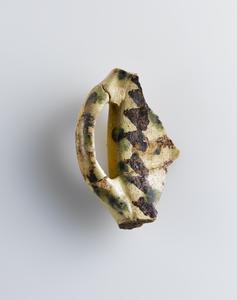
Fragments of glazed delftware fuddling cups have been excavated in South-
wark, and biscuit examples were found at Platform Wharf, Rotherhithef
Clusters of three or four vessels are most common for English tin-glazed
fud-
dling cups, but slipware versions (see nos. S76, S77) can have up to ten.i
Continental delftware fuddling cups typically are differentiated from English
ones based on shape (with individual vessels often of a somewhat smoother,
elongated baluster profile), decoration, body clay, and glaze characteristics.
1)290
1. Lipski and Archer, Dated Delftware, nos. 877
885. For an example with possibly modern
inscription ("1644 S:C"), see Sotheby's (L), Rous
Lench sale (1), July 1, 1986, lot 41.
2. For mugs, Lipski and Archer, Dated Delftware,
nos. 706 (1629), 722 (1644), 724 (1645), 729
(1650), 744 (1660); fbr a posset pot, no. 886
(1631).
3. Sotheby's (L), Lipski sale (2), November 17,
1981, lot 231.
4. Coleman-Smith and Pearson, l)onyatt, p. 40.
5. Archer, V&A, no. D.2; Stephenson comments
(September 1998), noting that the Rotherhithe
vessels all had lost their necks.
6. Coleman-Smith and Pearson, Donyatt,
pls. 27, 28; pp. 282-285, fig. 147.
316 The Longridge Collection
Copyright Jonathan Horn Publications 2000.| For information on re-use see: http://digital.library.wisc.edu/1711.dl/Copyright