Page View
Grigsby, Leslie B. (Leslie Brown) / The Longridge collection of English slipware and delftware. Volume 2: delftware
(2000)
Dishes and plates: European nautical scenes, pp. [132]-135
Page [132]
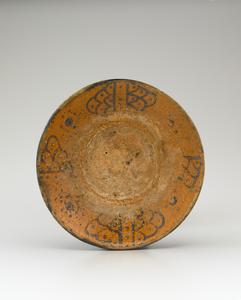
D97. DISH Bristol Number "10" on exterior c. 1740 H.: 1 7/8" (4.8 cm): Diam.: 13 1/8" (33.3 cm) BODY CLAY: Medium-grained buff. TIN GLAZE: Light bluish white with brown speckling and tiny blow holes. Somewhat runny and uneven on exterior. Overall, excluding portion of footrim edge. SHAPE: Molded Shape between D and E. DECORATION: Painted. Castle or fort on island with ships and figure-filled rowboat. Land in foreground with fence. Border composed of circle and brown edge. Exterior bears number 10" and double-stroke and leaf under rim markings. Ex colt.: Printed sticker "HHW/ number/104,' with "104" written in ink. 1. Admiral Edward Vernon (1684 1757). Ray, Warren, figs. 1-7, pp. 56-63; Archer, V&A, no. B.11, col. pl. 48; Britton, Bristol, pp. 159-160, no. 10.46, figs. 15-16. 2. Atkins, Exhibition (1993), no. 17. 3. Lipski and Archer, Dated Delftware, nos. 465- 468; Ray, Warren, pl. 25, nos. 63, 64; Austin, Delft, no. 261. 4. Grigsby, Chipstone, no. 59; Ray, Warren, pl. 10, no. 27, pp. 130 131. The corner ornament of a 1740 London map of'the Itarbour Town and Fort f Porto-Bello taken by Admiral Vernon Nov. 22d. 1739 includes four battleships matching those from the Fort Chagres engraving (Colonial Williamsburg collection, no. 1968-126). This scene appears to be a simplified version of one in an elaborate 1740 engraving titled An exact Account of Vice Admiral Vernon's taking the Castle & Town of Chagre in ye West-Indies. One of the ships in the engraving closely matches the large vessel near the right on the dish. Also in the engraving is an exploding- towered fort with an arched gate, a flag, and, in the foreground, a rowboat with figures differently posed from those on the dish shown here. Two impressive delft dishes titled "The taking of CHAGRE in the West Indies by Admiral VERNON" closely imitate the engraving's detailed design and are attributed to Richard Frank's Redcliff Back pottery in Bristol. The dishes' tower is identified as having the "flag of Truce hung out by Span." Another delft dish depicts "A View of the Hot Well" (after a 1731 engraving) and shows the Chagres engraving's men-in-a-rowboat motif. That dish, inscribed "Is F' over "1741/2," has under-rim markings and detailing of the water much like those on the Long- ridge dish. Although such initials and other criteria have led a group of often elegantly painted delftware pieces to be attributed to Joseph Flower,, the asso- ciation of the dish shown here with the group is tangential enough to preclude confident attribution. Another "10"-marked dish shows a different version of the exploding-tower Chagres scene,' and several 1740 dated "powdered ground" plates, like a flower brick in this collection (no. D374), depict towered forts, somewhat similar in design to the structure on the Longridge dish, with flags and sailing ships.3 Scenes on some dishes depicting Vernon's victory at Portobello, Panama, have been confused with views relating to Chagres.1
Copyright Jonathan Horn Publications 2000.| For information on re-use see: http://digital.library.wisc.edu/1711.dl/Copyright