Page View
Grigsby, Leslie B. (Leslie Brown) / The Longridge collection of English slipware and delftware. Volume 1: slipware
(2000)
Dishes and plates: birds and animals, pp. 76-[89]
Page 76
SI I P W ARE Dining and Related Wares
Dishes and Plates
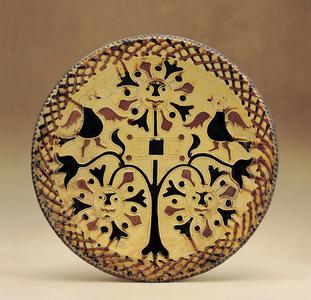
S17. DISH
Hanley, Staffordshire
Signed "IOSEPH:GLASS"
1695-1720
H.: 2 1/2" (6.4 cm):
Diam.: 18 1/2" (47 cm)
BODY CLAY: Medium grained orange
with inclusions.
LEAD GLAZE: Overall on interior.
SHAPE: Thrown. Shape F with less
pronounced ridge at upper edge.
SLIP GROUND: Cream-colored
Overall on interior.
DECORATION: Trailed and jeweled.
Pelican(?) with string-of- bead -type and
floral filler ornament. Signed
"IOSEPH:GLASS" in trellis-border
reserve.
Published: Home, Collection, pr. I no. 483.
Birds ond Animols
Tihe birds on this dish and on number S18 in the following entry resemble
types shown with three chicks onl trellis-bordered "Pelican in her Piety"
dishes
depicting a popular Christian theme of self-sacrifice. On such dishes, the
moth-
er bird pricks her breast to feed her blood to her starving young. Pelican
in her
piety dishes typically are undated, and examples are signed by Thomas loft,'
Ralph Simpson, or, in one case, initialed "RW." The earliest date
on an English
slipware dish showing a somewhat similar large bird is 1676 and is found
with
Ralph Toft's signature. Late sixteenth- and seventeenth-century trailed dishes
froin North Holland also depict long-necked birds, some with raised wings
and
small dashlike elaborations to the backs of the heads and necks.
Josiah Wedgwood's list of Staflirdshire potteries active around 1710 to
1715
includes Joseph Glass of tlanley, who made "Clowdy and a sort of dishes
paint-
ed with Idifflrentl color'd slips." Glass sold these pieces by the dozen
tor three
shillings or three shillings six pence (a depressing figure when compared
to
modern prices!), probably depending on the diameter of the dish." Glass's
sig-
nature is found on a 1703 cradle ornamented with wigged heads and an undat-
ed, nmultihandled cup with the initials "SV HG." The Glass family
continued to
produce pottery in Staffordshire into the nineteenth century.'
I. Dean. Malkin )ish, p. 162, pl. 7; Cooper,
Slipware Dishes, phs. 185 191, 193.
2. Cooper, Slipware D)ishes, phs. 194 195.
3. tbid,, p1, 192. For an uninscribed example,
see Mint Musetun, tlelhoin Gallery, no. 197.
For a soinewhat silmilar "wriggle-work" bird on
a 1661 pewter dish, see D~ean, Malkin D1ish,
p. 162, pl. 6.
4. lritish Museum collection (Franks,
no. 1887.0210.3).
5. van Gangelen, Kersloot, and Venhuis,
Slibaardewerk, col. pis. 144a 144b.
6. Brears, History, p. 205.
7. For cradle, see Rackham, Glaisher, vol. 2,
pl. 23F, no. 254, and Ltomax, p'ottery, p 80,
fig. 4:3. For cup, see Htobson, British Museuint,
p. 115, no. )64. For an unsigned but similarly
initialed 170:3 dish, see Rackham., Glaisher,
vot. 1, no. 222.
8. Liomax, pottery, p. 91.
76 The Longridge Collection
Copyright Jonathan Horn Publications 2000.| For information on re-use see: http://digital.library.wisc.edu/1711.dl/Copyright