Jump to:
19th Century Janesville Photos in Books |
Walking Guides to Historic Districts |
Gruver Photograph Collection |
Case Postcard Collection |
Additional Resources |
Funding |
Technical Note |
Copyright
About Hedberg Public Library's Digital History Collection
Milwaukee and Main Street (1882)
Janesville, Wisconsin
Janesville, located in southern Wisconsin near the Illinois border, was settled in 1835, making it one
of the earliest communities in the state. In 2005, it was Wisconsin's 11th largest city and one of the
fastest growing in the 1990s. Its 2000 population was 60,200. Thirty-nine percent of the total Rock
County population lives in Janesville. The photographs digitized on this Web site present views of
Janesville from its earliest days in the 1840s to the 1980's.
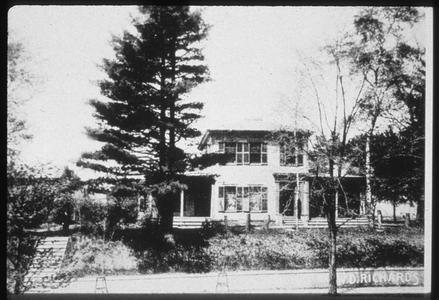
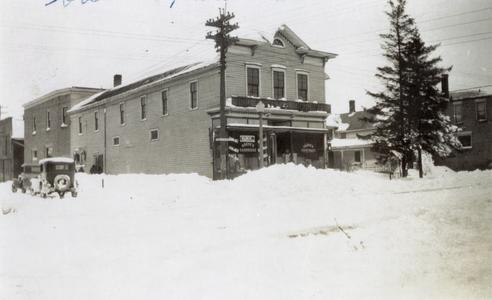
The 20th century is represented by the Gruver Photograph Collection. The photographs
in this collection were taken or collected by amateur photographer Lowell "Bud" Gruver (1904-1997). Late in
life, Gruver embarked on a project to record Janesville scenes and buildings, viewing contemporary Janesville
through eyes that remembered the past. The photographs in this collection were significant to him, not just
for what they currently recorded, but for what no longer remained. For example, an undistinguished gas
station and convenience store were important to Gruver because they were located on land that had once housed
part of the Janesville Coaster Wagon Factory. When he photographed the Case, Feed, and Produce Company on Rockport
Road, his caption reveals that he was recalling the Roesling Bros. grocery store that preceded it. An avid collector
of photographs, Gruver often paired an historical photograph of a Janesville scene with its contemporary image.
Photos of Janesville's downtown -- particularly of Main and Milwaukee Streets -- include both the way it looked
in the past and the way it looked in the 1980s. Dramatic changes in Janesville's cityscape particularly
fascinated Gruver, and his collection includes several photos of fires, building demolitions, and street
reconstruction projects.
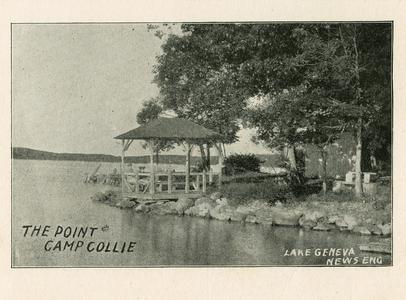
Supplementing the Gruver collection are selected images of historical Janesville
from the postcard collection that Debra Case, a librarian at Janesville's Hedberg Public Library, generously
loaned for this digitization project.
Nineteenth-century views of Janesville and the Rock River come from George W. Wise's
Picturesque Janesville Illustrated (1888), The Art Work of Rock County (pre-1893), The Headlight
Magazine (Souvenir Edition, 1896), The Janesville Fire Department Souvenir Album (1902), and a series of
walking guides to Janesville historic districts produced by the Janesville Historic Commission (1986-1995).
Together, these 19th- and 20th-century sources depict Janesville's rich past.
19th Century Janesville Photos in Books
Jump to:
Art Work of Rock County |
The Headlight Souvenir Edition: Janesville, Wis. |
Janesville Fire Department Souvenir Album |
Picturesque Janesville
|
Art Work of Rock County, published in 1893, consists primarily of photographs of Janesville, Beloit and
Evansville, Wisconsin, including public and commercial buildings, Rock River scenic views, residences, dirt
road street scenes, churches, schools and other images. Many of the structures depicted here no longer exist.
Approximately 21 percent of the book's pages present the unique early history of Rock County, Wisconsin, and
the Rock River area. Indian mound and village locations and descriptions, Indian treaties affecting the area,
and information about Chief Black Hawk's local movements during the 1832 war are included in the text. The
history of the earliest white settlement of the Rock River area includes the system of unwritten border law
pertaining to squatters' claims, steamboat and railroad development, pioneers, and town development. The text
concludes in 1861 at the beginning of the Civil War.
|
|
The Headlight Souvenir Edition: Janesville, Wis. was a special issue (volume 10, no. 4, May 1896) of the
serial publication Headlight: a Journal of Progress and Development.
The Headlight was designed to attract new business and residents to Janesville.
It was "intended to set forth the advantages of Janesville, Wisconsin, as an industrial location, [and] as a place
of residence" with a "pictorial part — show[ing] a few of its many beauties." In an era when the Janesville
population was 15,000, highlights includes a brief town history; biographical capsules of the mayor, councilmen,
and leading citizens; a summary of public schools and the Wisconsin School for the Blind; and information on early
newspapers, financial institutions, and a leading Wisconsin law firm of the time. Hotels, including the Myers House,
which was "one of the oldest and most widely known hotels in the Northwest," are featured. Manufacturing companies
are described, including those for corn planters, carriages, knitting and woolen mills, beverages, transportation,
and farm machinery. Many photographs feature business interiors as well as exteriors. Janesville was also the
center for the Wisconsin tobacco market with related industries. The Headlight also claims Janesville as "the
commercial center of Southern Wisconsin" and describes the city's virtues.
|
|
The Janesville Fire Department Souvenir Album, a book published in 1902 by the local newspaper for the Firemen's
Relief Association, is not only a pictorial history of 19th century Janesville firemen and their horse-drawn
firefighting equipment but also a record of the residences and commercial establishments they protected.
Business interiors -- including local saloons and beer halls as well as Janesville retail and manufacturing firms
-- are a significant feature of this book.
The text includes the business cards of physicians, dentists, and many retail firms and
commercial offices. A 50-year historical sketch of Janesville firefighting history is covered in
two pages, while the last 16 pages provide the following lists: significant Janesville events from 1835-1902;
Janesville churches; city and county officials and local postmasters; Rock County representatives in state and
territorial government; labor and fraternal societies; state fairs held in Janesville; and even the location of
Janesville fire alarm boxes.
|
|
Picturesque Janesville, published in 1888, consists of photographs of Janesville residences, schools, churches, street
scenes, bridges and dams. Many of these structures no longer exist.
The author's note states: "In presenting this work of Art to the public, permit me to
say that in many respects it differs from any work ever offered to the people of Janesville. It is different not
only as a work of Art but in the style of illustrations, and is a fair specimen of advanced photography, known among
artists as 'Photo-Graveure,' or 'Photo-Mechanical Printing,' being printed on an ordinary printing press from
negatives taken by myself. This collection embraces our most prominent buildings, residences and the scenery
surrounding our home. In making the collection an effort has been made to select views that would be a fair
representation of the best. It would have been a pleasure to me could I have enlarged the size of this work,
but in such case it would have been too expensive to be within the reach of many. In offering you Picturesque
Janesville, I give you a work of Art, believing that those who possess it would prefer looking elsewhere for a
descriptive history of our city than have its pages encumbered with printed matter."
There is no text apart from the name of the building or place featured in the photographs.
|
Walking Guides to Historic Districts
Jump to:
Prospect Hill and Conrad Cottage area of Janesville |
Old Fourth Ward: Historic District |
Court House Hill Historic District: A Guide |
Main & Milwaukee Janesville's Downtown Historic District: A Guide |
Benton Avenue Historic District: A Guide
|
Guidebook for a walking tour in the Prospect Hill and Conrad Cottage area of Janesville. Historic and architectural
descriptions of residences and businesses are provided. Written and designed by Carole Zellie of Landscape Research,
St. Paul, Minnesota, for the Janesville Historic Commission.
Prospect Hill Historic District surrounds one of Janesville's highest hills and overlooks
the Rock River and downtown. Early pioneers settled this area by 1845, though only 25 buildings were built before
1870. Another 39 buildings were constructed between 1870 and 1900. One reason for the delayed settlement of this
area was its steep slope. The district, which spans approximately 15 blocks, was added to the National Register
of Historic Places in 1992, the fourth historic district in Janesville to be added.
The Conrad Cottages Historic District is located near the Prospect Hill District.
Included in this district are four similar cream-colored brick workers' cottages built by Charles B. Conrad in 1882.
|
|
Guidebook for a walking tour in the Old Fourth Ward area of Janesville. The area extends from the southwest edge of
downtown to the Rock River. Historic and architectural descriptions of residences and businesses are provided.
This guidebook was written and designed by Carole Zellie of Landscape Research, St. Paul, Minnesota, for the
Janesville Historic Commission.
The Old Fourth Ward is one of Janesville's largest and oldest residential sections,
composed of more than 900 structures in central Janesville. The district is actually a mixture of three historic
neighborhoods: Near Downtown, Monterey and Rockport. The structures in Near Downtown are a mix of the Greek Revival
and Italianate homes of the city's business leaders and cottages of quarry workers. Most date from the 1850s.
Development of Monterey began in the 1840s around the ferry and bridges that spanned the Rock River between Center
Avenue and Rockport Road. Ira Miltimore, an experienced mason and engineer, established the Monterey Quarry on the
south side of the river in 1845. Quarry workers lived in small cottages on the north side of the river.
Rockport was established as a separate village after the Civil War. First settled by Judge William Holmes in 1836,
the village was platted by Holmes' son, Thomas. The plot he set aside as public land for a courthouse is Fourth
Ward Park.
|
|
Guidebook for a Janesville walking tour of the Courthouse Hill Historic District. Historic and architectural
descriptions of residences and businesses are provided. Written and designed by Carole Zellie of Landscape Research,
St. Paul, Minnesota, for the Janesville Historic Commission.
Rising above the city of Janesville on the east side of the Rock River, this historic
district contains outstanding examples of the architectural styles seen throughout Janesville from its founding
in the mid-19th century through 1930. The 30-block district contains 219 properties and was listed on the National
Register of Historic Places in 1986. Many of the blocks were contained in Henry Janes' original claim.
|
|
Guidebook for a Janesville walking tour of the Downtown Historic District. Historic and architectural descriptions
of residences and businesses are provided. Written and designed by Carole Zellie of Landscape Research, St. Paul,
Minnesota, for the Janesville Historic Commission.
Main and Milwaukee streets are the heart of the city. Janesville's central business
district reflects the city's origins as a river city. Close study of many of its buildings reveals information
about their past uses, previous owners and architectural styles.
|
|
Guidebook for a walking tour in the Benton Avenue area of Janesville. Historic and architectural descriptions
of residences and businesses are provided. Written and designed by Carole Zellie of Landscape Research, St. Paul,
Minnesota, for the Janesville Historic Commission.
A small area of urban bungalows is the focus of the Benton Avenue Historic District.
Built following World War I during a decade of substantial economic growth and development, Benton Avenue offered
low-cost tract housing to the workers of Janesville's General Motors factory.
|
The Gruver Photograph Collection: A Collection of Historic and Current Photographs of Janesville, Wisconsin collected by Lowell ("Bud") Gruver of Janesville, Wisconsin
In 1986, Lowell "Bud" Gruver, a longtime Janesville resident, local historian, and avid
photographer, donated his collection of over 1,000 historic photographs of Janesville people and places to the
Janesville Public Library. In donating the collection to the library, Gruver's goal was to share Janesville
history with all interested residents and visitors. Digitizing much of his collection on the Web extends Gruver's
reach to an even larger and farther-flung audience. An unusual aspect of this collection is the knowledge of
Janesville's past that Gruver brought to his project. Photographing Janesville buildings in the 1980s, Gruver
recalled (in narratives accompanying the photos) the buildings and businesses that had preceded them and often
tracked down older photos of those establishments, which he paired with the contemporary ones.
|
Postcards from the collection of Debra Case on loan to the Hedberg Public Library for the purposes of this digitization project.
Copies of the postcards are available at the library, though the originals remain in the collector's possession. The cards represent views of the city prior to the 1930s.
|
Additional Resources
Funding
Digitization of Janesville's Past is collaborative project completed by the UWDCC and the Hedberg Public Library.
Digitization of Janesville's Past was funded, in part, through a 2005 Library Services and
Technology Act (LSTA) grant. This grant provided financial support for
public libraries to digitize and make available online, their local
library resources. For more information about LSTA grants in Wisconsin,
contact the Wisconsin Department of Public Instruction (DPI) Division
for Libraries, Technology, and Community Learning or visit the LSTA
grant Web site at http://www.dpi.state.wi.us/dpi/dltcl/pld/lsta.html.
Technical Note
Please note that full-text searching for the electronic-facsimile texts in our collections is based on
uncorrected OCR (Optical Character Recognition) results. While such text is often highly accurate, it will
contain errors that may affect your search results. In particular, texts with the following characteristics
are particularly prone to error (in some cases, accuracy for such texts is so low that we have decided not to
attempt to provide full-text searching):
- Hand-written texts;
- Texts that contain diacritics;
- Texts that contain non-Latin scripts;
- Texts that contain obsolete characters (including the "long S" [looks like an "f"]);
- Texts that are printed in a font in which the letters are difficult for the software to differentiate.
Copyright Information
These materials may be copied freely by individuals and libraries for personal use, research, teaching
(including distubution to classes), or any other 'fair use' as defined by U.S. copyright laws. Please
include this statement and author or photographer attribution with any copies you make. The materials
may be linked to freely in non-commercial, non-subscription Internet editions created for an educational
purpose.
Anyone interested in any other use of these materials, including for-profit Internet editions, should obtain
permission from Hedberg Public Library which retains copyright for all other purposes. Contact Hedberg Public
library through the Reference Department, Hedberg Public Library, 316 S. Main Street, Janesville, Wisconsin 53545
(hplref@als.lib.wi.us).