Website Search
Find information on spaces, staff, and services.
Find information on spaces, staff, and services.
The History of Science and Technology Collection brings together in digital facsimile two categories of primary and secondary publications:

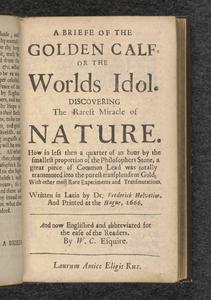

![The marrow of alchemy : being an experimental treatise, discovering the secret and most hidden mystery of the philosophers elixer : divided into two parts, the first containing four books chiefly illustrating the theory, the other containing three books, elucidating the practique of the art : in which, the art is so plainly disclosed as never any before did for the benefit of young practitioners, and the convincing those who are in errours laby.inth [Part I]](https://asset.library.wisc.edu/1711.dl/LHQSHEOYXDY3B8A/M/h300-f59dd.jpg)





![Raimundi Lulii maiorici philosophi acutissimi, mediciq[ue] celeberrimi, De secretis naturae siue quinta essentia libri duo : his accesserunt, Alberti Magni summi philosophi, De mineralibus & rebus metallicis libri quin[que] ; quae omnia solerti cura repurgata rerum naturae studiosis recens publicata sunt per M. Gualtherum H. Ryff, Argentinensem, medicum](https://asset.library.wisc.edu/1711.dl/KAPEO7FAXKHDW9A/M/h300-51f30.jpg)
This compilation (including design, introductory text, organization, and descriptive material) is copyrighted by University of Wisconsin System Board of Regents.
This copyright is independent of any copyright on specific items within the collection. Because the University of Wisconsin Libraries generally do not own the rights to materials in these collections, please consult copyright or ownership information provided with individual items.
Images, text, or other content downloaded from the collection may be freely used for non-profit educational and research purposes, or any other use falling within the purview of "Fair Use".
In all other cases, please consult the terms provided with the item, or contact the Libraries.
Copied!