|
White's The Bestiary: A Book of Beasts was the first and, for a time, the only English translation of a medieval bestiary.
Bestiaries were second only to the Bible in their popularity and wide distribution during the Middle Ages.
They were catalogs of animal stories, combining zoological information, myths, and legends.
Great attention was given to bizarre, exotic, and monstrous creatures. Much of the content of bestiaries was
drawn from much older sources including Aristotle, early English literature, and oral traditions.
White provides an excellent appendix that explains how the creatures of the bestiary influenced the development
of allegory and symbolism in art and literature.
|
|
A Comparative View of the Human and Animal Frame by Benjamin Waterhouse Hawkins was published in 1860.
This work fits into the second category of materials on the History of Science and Technology Web site, that is,
unique or valuable titles in science and technology held by the UW-Madison Libraries. Hawkins' intent was
"to give a comparative view of the variation in form of the bony skeleton or framework of those animals
most frequently required by the artist, designer, or ornamentist." The animals represented are some of
the most familiar and important, such as the lion, the horse, the bear, the gorilla, and others. The textual
explanations of variation in animal form did not yet reflect the influence of Charles Darwin's evolutionary
theory, but the detailed illustrations added much to the understanding of mammalian anatomy.
|
|
This collection of correspondence, written mostly to Sir Joseph Banks (1743-1820), provides insight into the history
of science, natural history, Sir Joseph Banks' life, Iceland, and early travel and world exploration. A British explorer
and naturalist who, as long-time president of the Royal Society, London, circumnavigated the globe with Lieutenant James
Cook on HMS Endeavour, 1768–1771, taking with him a team of naturalists, illustrators, and assistants. He made unprecedented
collections of flora and fauna from many parts of the world. Banks also led the first British scientific expedition to Iceland
in 1772. The collection also contains letters, notes, and memoranda written by Banks during this expedition. The materials range
from 1772 to 1818. The original materials, including hand-written correspondence, are housed in Special Collections at UW
Memorial Library. Because the collection contains handwritten material it is, unfortunately, not full-text searchable at this time.
|
|
Ephraim Chambers' acclaimed eighteenth-century classic, Cyclopaedia, or, An Universal Dictionary of Arts and Sciences… ,
in two volumes, appeared in 1728. The Supplement, also in two volumes, followed in 1753.
Noteworthy features of this distinguished work, the first edition, include the use of cross-references; the Dedication
to the King, George II, and the compiler's "Plan of the Work," within the prefatory section, volume one.
The Cyclopaedia is held in the Special Collections Department, Memorial Library, University of Wisconsin-Madison.
|
|
The Department of Chemical Engineering Technical Papers were written by University of Wisconsin chemical engineers between 1900 and 1935.
There are five volumes containing 190 papers. The papers have been made available online because they show the development of the
field of electrochemistry, which was the early emphasis of this department. Additionally, they provide a history of the University
of Wisconsin's Department of Chemical Engineering itself.
|
A description of the nature of four-footed beasts : with their figures engraven in brass (1678). Jonstonus, Joannes, 1603-1675.
http://digital.library.wisc.edu/1711.dl/HistSciTech.Jonstonus
Joannes Jonstonus, 1603-1675 (var. names: John Johnstone, Jan Jonston), was a naturalist, historian, educator and physician, born in Poland to a family of Scottish
descent. Well-travelled and well-educated, Jonstonus compiled richly illustrated encyclopedias on botany and zoology that appeared in several editions and several
languages. A Description of the Nature of Four-footed Beasts is the 1678 London edition, translated into English, of Jonstonus'
earlier Latin "Historiae naturalis de quadripedibus." This volume contains 80 engraved illustrations at the end of the volume. Tabulae X through XII and
pages 19-21 may be of special interest to those curious about seventeenth century knowledge of unicorns. The source text for this online facsimile is housed
at UW-Madison, Memorial Library Special Collections, at Thordarson T 2036.
|
|
Published anonymously in the latter part of the 18th century, Geheime
Figuren der Rosenkreuzer or Secret Symbols of the Rosicrucians is a
critical document explaining the source of Rosicrucian ideas. Dating to
the early 17th century, the Rosicrucians are highly contentious. Some
scholars view the group as alchemists, others as a group wishing to
promote social reform. This addition of Geheime Figuren contains
beautiful illustrations of the symbols that were central to the
followers of the Rosy Cross.
|
|
Luther Burbank: His Methods and Discoveries. A 12-volume monographic
series documenting Burbank's methods and discoveries and their practical
application, prepared from his original field notes covering more than
100,000 experiments made during forty years devoted to plant
improvement. Created with the assistance of the Luther Burbank Society
and its entire membership, under the editorial direction of John Whitson
and Robert John and Henry Smith Williams.
Burbank (1849–1926) was one of North America's foremost American plant
breeders. He experimented with thousands of plant varieties and
developed many new ones, including new varieties of prunes, plums,
raspberries, blackberries, apples, peaches, and nectarines. Besides the
Burbank potato, he produced new tomato, corn, squash, pea, and asparagus
forms; a spineless cactus useful in cattle feeding; and many new
flowers, especially lilies and the famous Shasta daisy.
|
|
Memoir's for a natural history of animals: containing the anatomical
descriptions of several creatures dissected by the Royal Academy of Sciences at Paris.
|
Micrographia: or some physiological descriptions of minute bodies made by magnifying glasses : with observations and inquiries thereupon (MDCLXVII [1667]). Hooke, Robert,1635-1703.
http://digital.library.wisc.edu/1711.dl/HistSciTech.HookeMicro
British natural philospher Robert Hooke (1635-1703) was a major figure in the history of science, and his most famous work, Micrographia: or some physiological
descriptions of minute bodies made by magnifying glasses…, is reproduced here, from the 1667 second issue held at UW-Madison, Memorial Library Special Collections,
at Thordarson T 1988. (See further information in a virtual exhibition on the "
History of the Printed Scientific Book.") Hooke has been called the first professional research scientist employed specifically to enquire into the phenomena and
principles of nature, based on his 1664 salaried appointment at the Royal Society of London. In Micrographia he describes, explains and speculates about his
microscopic observations of plant tissue, insects, crystal structures, snowflakes, and more. Thirty-eight detailed engravings (schemata) document Hooke's close-up
views.
|
|
In the inaugural volume of Nature, in his article "Nature: Aphorisms from Goethe," T. H. Huxley wrote: "When another half-century has passed, curious readers of the
back numbers of NATURE will probably look on our best, 'not without a smile;' and, it may be, that long after the theories of the philosophers whose achievements are
recorded in these pages, are obsolete, the vision of the poet will remain as a truthful and efficient symbol of the wonder and the mystery of Nature." As Huxley
foresaw, this collection of Nature provides insight into the developments and achievements of science at the end of the nineteenth century.
|
|
Paul F. Clark, professor emeritus of Medical Microbiology, began his career at the University in 1914,
retiring thirty-eight years later in 1952. He was the first chairman of the University of Wisconsin-Madison
Department of Medical Bacteriology. Pioneer Microbiologists of America was published by the University
of Wisconsin Press in 1961. Clark's work was an attempt to chronicle and interpret early American microbiology
beginning in the nineteenth century and ending around 1916. As a history of American microbiology, this work
is even richer because Clark knew many of the people about whom he wrote, including Fred, Baldwin, and McCoy.
|
|
Root Nodule Bacteria and Leguminous Plants by Edwin Broun Fred, Ira Lawrence Baldwin, and Elizabeth
McCoy first appeared seventy years ago as part of a series, University of Wisconsin Studies (no. 52, Science no. 5),
published by the University of Wisconsin in 1932. This work summarized published research in biological
nitrogen fixation from approximately 1576 through 1930. A pioneering effort that brought together years
of source material from English, German, French, Italian, Dutch, and the Scandinavian languages,
Root Nodule Bacteria and Leguminous Plants was a thorough and critical examination that not
only synthesized research findings in light of then-current knowledge, but also suggested areas where
new research was needed.
|
|
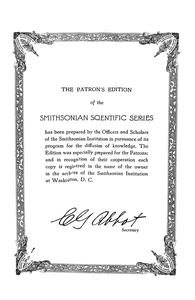
The Smithsonian Scientific Series is intended to enlighten and interest the general reader. It does not represent an attempt to summarize
all science, or even all branches of science on which the Smithsonian can speak with authority. It will, however, acquaint the reader
with the organization, history, and activities of the scientific institution which has grown up with the nation and fostered the nation's
scientific activities. It is an introduction to the workings and achievements of the scientific method over a large field, and may
open doors to some branches of science.
|
Wohlmeinende, treue, und sehr nützliche Ermahnungen an die Anfänger in dem tiefsinningen Studio der Hermetischen Philosophie
http://digital.library.wisc.edu/1711.dl/HistSciTech.Mosch
A work by (the tongue-twisting) Johann Anton Moscherosch von Wißelsheim typifies the strengths
of the history of science collections in the Department of Special Collections. The book, entitled
Wohlmeinende, treue, und sehr nützliche Ermahnungen an die Anfänger in dem tiefsinningen Studio der
Hermetischen Philosophie
(Nuremberg: George Bauer, 1765), speaks to issues of early modern science, philosophy, and the
occult, and fits with other holdings of Special Collections, notably the Duveen Collection of Alchemy
and Chemistry and important holdings (especially pre-1801) for philosophy and theology. This electronic
facsimile provides broader access to a fragile and rare work by providing an overview of the structure
of the text.
|